
Canberra’s Floriade was in its last week of marvellous displays of colourful flowers and various displays. The weather was beautiful (if rather chilly in the mornings) and our accommodation at Camp Cottermouth was the perfect rural location, some 20kms west of Lake Burley Griffin, very close to the lovely lacy-fall of the Cotter Dam.
Of the 64 participants of all grades, 40 were staying at the camp facility where we were well fed and housed in comfortable camp conditions. The staff went to lengths to see we were welcome and they catered well to about 10 with special dietary needs. 24 others stayed at Alivio Tourist Park or were dotted around the city with friends or relatives.


It was a bit of a logistic nightmare to organise such an extended group. We had Happy Hour about 5.30pm while nibbling on cheese, crackers and vegetable sticks. It was at this time we consulted the map and signed up for the next day’s walk. If the outlying members didn’t attend then they still had to sign up their intention and be very sure of the start point for next morning’s departure.


Many of us had flown over or shared cars to reach Canberra so there was a short list of vehicles available to transport us to and fro. We kept them busy and, of course, they were very much appreciated and refunded for their mileage.
Four walks were offered each day (A, B, C and D).
Day 1, to limber up, was around the eastern end of Lake Burley Griffin. Up ANZAC Pde. with its large impressive sculptures to all past wars of our fallen young men and women. We even stopped the traffic for mother duck and about 6 tiny little fluff-balls to at least cross safely to the median strip. Onwards we climbed Mt Ainsley (didn’t need boots for this) with views over the lake to new and old Parliament Houses. A’s went on to also tackle Black Mountain. Then it was a quick stroll through Floriade to cross Commonwealth Ave bridge back to our cars.

Our 2nd day was south of the city on Isaac Ridge passing 2 trig points through dry bushlands and into the cool of the pine forest. We crossed under a busy road to climb to a 3rd trig. It was quite warm but we had views over the city. A very sneaky magpie stole a lunch wrap off a lap. Back under the road and return. This was the only walk where the B’s managed to walk further than the A’s because of our mis-calculation in the many trails.

Day 3 was a linear walk along the side of the Murrumbidgee Corridor, unfortunately not down by the water but gradients up and down the hillside with a stretch over private paddocks. Lovely views of placid water interspersed with short rapids and obviously a healthy wombat population judging from all the wombat droppings under foot. At the end of the day we climbed steeply to walk right back into camp. A’s continued on to Casuarina Sands. D’s had spent time exploring the near-by Cotter Dam area. It was in this area, near our accommodation, that 3 boars were seen and our only snake sighted.
The rest day spread us wide, there was plenty to do. Parliament House tour was popular, National Galleries, the colour and splendour of the Floriade. (All I visited were free entry!) Others visiting friends or just a coffee and lunch with a grand view. It was certainly not a place for casual shopping. Some opted to drive or walk the National Arboretum which was on the D walk program and sighted a rather large echidna strolling by.

We resumed the walking program further south to the Bullen Range. B’s set out to a distant trig and were supposed to drop down off the hilltop service track to check out the former homestead of Calvary ruins. Unfortunately, we didn’t notice we had over-shot the descent until too late, therefore missed it.
The trail was pretty straight with ups and down before a down-hill curve gradient to the Tidbinbilla Deep-Space Tracking Centre. This base had 6 huge satellite dishes pointing in all directions plus a sprinkling of smaller ones. The high wire fence had strong security lights and cameras. All very neat and secure.

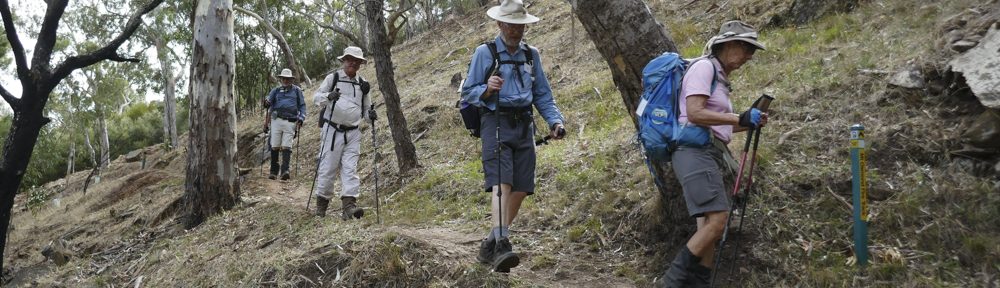
Back in 2003 the destructive bushfires hit the Namadgi National Park area (and much of western Canberra) and our walking here was a delight. Big blackened tree trunks stood like tall poles but the undergrowth was flourishing to head height with bushes in full bloom. Common was the yellow thin leaf pea and the pretty Australian Indigo. Some spotted birds of all kinds and tiny orchids.
The trail crossed moist sections with stepping stones or metal grids, then it was a climb up the ridge with many steps. On top the wind hit the cliff-face and roared over us. We decided to retreat back downhill for a sheltered lunch. The A’s travelled along the ridge to rocks at the far end.


The last day’s walk, at Tidbinbilla Nature Reserve, began at Honeysuckle Creek car park. This was the site of the NASA Earth station instrumental to the Apollo mission tracking, now removed but well presented with numerous historical displays. From here we had a lovely walk, almost a loop, with the B’s climbing to a lookout protruding over the valley we were walking through. The A’s climbed higher to the ridgetop to explore the giant Booroomba Rocks and caverns. The last bit of the loop was on a nature trail adjacent to the Birragai Outdoor School and passing a cluster of more huge rocks on the valley floor.


All in all, Canberra had a lot to offer and is aptly known as the ‘Bush Capital’ of Australia. One aspect of their gates on the more popular walks was the rectangular hole just below the top bar. This allowed us to climb through with our backpacks without climbing over or through barbed wires, etc.
This was the 3rd Canberra camp ARPA (now Retired Active) has done and although a long and expensive trip it was certainly a camp with a difference. The organisers, voluntary team leaders, drivers, those who kept records of money, signup sheets, and many others made it all run smoothly, and our many thanks to their dedication. A job very well done


You must be logged in to post a comment.